

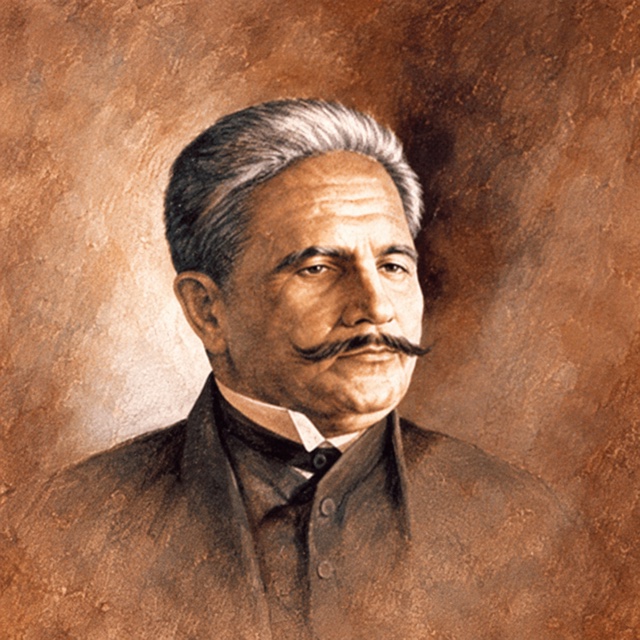
Poet
Allama Iqbal
Allama Muhammad Iqbal (1873–1938) was one of the great poets, thinkers, philosophers, and reformers of the Indian subcontinent. Born in Sialkot, he left a distinguished body of work in both Urdu and Persian that profoundly shaped the intellectual, literary, and cultural life of the twentieth century. He is a central figure in modern Islamic thought and one of the last great poets of the Persian tradition.
Iqbal studied in Sialkot, Lahore, Cambridge, and Munich. He possessed a deep knowledge of philosophy, law, history, Sufism, and Islamic civilisation. The central idea of his poetry is khudi, or the self, through which he urged the individual to recognise inner strength, moral dignity, and creative possibility. Love, freedom, movement, action, and the spiritual awakening of the Muslim community are equally important themes.
His Persian works include Asrar-e Khudi, Rumuz-e Bekhudi, Payam-e Mashriq, Zabur-e ʿAjam, Javid-nameh, Musafir, Pas Che Bayad Kard ey Aqwam-e Sharq, and Armaghan-e Hijaz. In them he addresses the human person, the cosmos, religion, civilisation, ethics, and mystical experience with intellectual depth and poetic force. Both in scale and in philosophical range, his Persian poetry forms the larger part of his poetic work.
Iqbal regarded Jalal al-Din Rumi as his spiritual guide and brought the classical tradition of Persian poetry into conversation with the intellectual demands of the modern age. His work has been translated into many languages and remains widely read in scholarly, literary, and intellectual circles in both East and West.
Allama Iqbal died in Lahore in 1938 and was buried beside the Badshahi Mosque.