
A Historic Collaboration
ZindeRood and Ganjoor: A Historic Partnership for Persian Literary Heritage
ZindeRood is proud to work with Ganjoor, the world’s most trusted digital platform for Persian poetry, across several important areas.
Introducing Ganjoor and its quiet revolution
Ganjoor is a trusted Persian poetry website that has quietly transformed the way Persian verse is shared around the world. Its founder, Hamid Reza Mohammadi, is a respected software engineer whose selfless work has led admirers to call him an ascetic of the digital poetry world. Ganjoor is much more than a website. It is an ecosystem of roughly a dozen software projects that allows Persian readers everywhere to explore a shared literary inheritance, add to it, correct errors, and obtain the data freely through open-source systems. Its open data has already supported new Persian-language websites, mobile applications, and AI tools.
Ganjoor’s open-source philosophy
All texts and audio recordings on Ganjoor, together with more than a dozen software projects maintained under its name, are fully open source and may be reused for other purposes.
Ganjoor explains this philosophy on its About Ganjoor page as follows:
”به حکم «دگران کاشتند و ما خوردیم، ما بکاریم و دیگران بخورند» گنجور نیز اشعاری را که از منابع دیگر نقل کرده به صورت دورهای و در قالب پایگاه دادههای نرمافزار آزاد و رایگان گنجور رومیزی منتشر میکند تا گروهها و علاقمندان دیگر بتوانند با استفاده از این مجموعه کارهای مشابه گنجور را انجام دهند و در مجموع گامهای بیشتری در جهت انتشار آزاد ادبیات فارسی برداشته شود.“English translation: Guided by the saying, “Others planted and we ate; let us plant so that others may eat,” Ganjoor periodically publishes the Persian poetry it has gathered from other sources as an open database for its free desktop software. This allows other groups and interested individuals to use the material in projects of their own, including work similar to Ganjoor, and to play a part in making Persian literature freely available to a wider public.
Avaye Ganjoor is Ganjoor’s audio recordings section. Its How to Contribute page states:
”ضمناً با ارسال خوانش خود به گنجور پذیرفتهاید که اثرتان بدون محدودیت و به طور آزاد چه در کارهای رایگان و چه در کارهای تجاری قابل استفادهٔ مجدد باشد. تنها شرط الزام شده از طرف گنجور ذکر نام گوینده و منبع اولیه است...“English translation: By sending your audio recording to Ganjoor, you agree that it may be reused without restriction in free and commercial projects. Ganjoor’s only requirement is to credit the reciter and the original source.
All of Ganjoor’s software is also open source and can be viewed on GitHub.
ZindeRood’s vision and belief in open source
Persian poetry has no comprehensive, community-led open-source home in English comparable to Ganjoor. ZindeRood was created with this absence in mind and has embraced Ganjoor’s open-source philosophy. Our aim is to build such a home for English-speaking readers, where translations and carefully corrected texts are openly available for everyone to use.
ZindeRood’s work and contributions to Ganjoor
The relationship between ZindeRood and Ganjoor is a genuine exchange. ZindeRood has contributed to Ganjoor’s work in the following ways:
- Audio contribution: Ganjoor previously had no recordings of Iqbal’s poetry. After review by the Ganjoor board, more than 170 recordings in the voice of ZindeRood founder Makhdoom Hassaan Lahori were published on the platform. In recognition of this work, Ganjoor also published a special blog post on its website.
Evidence
Ganjoor’s tribute to ZindeRood’s founder
Selected visual evidence from Ganjoor’s special blog post and the relevant Avaye Ganjoor pages.
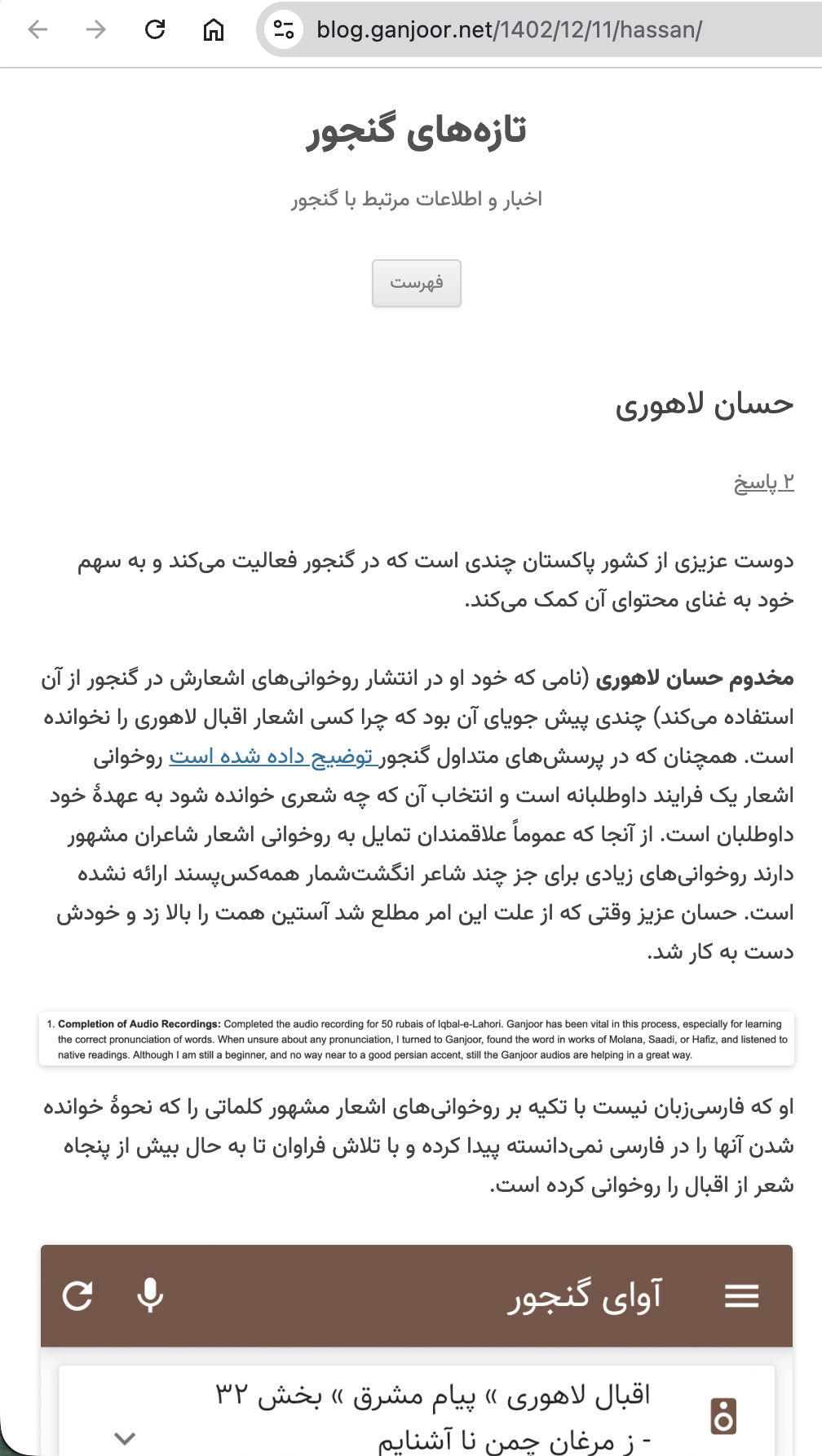
An introduction to ZindeRood’s founder on the Ganjoor blog 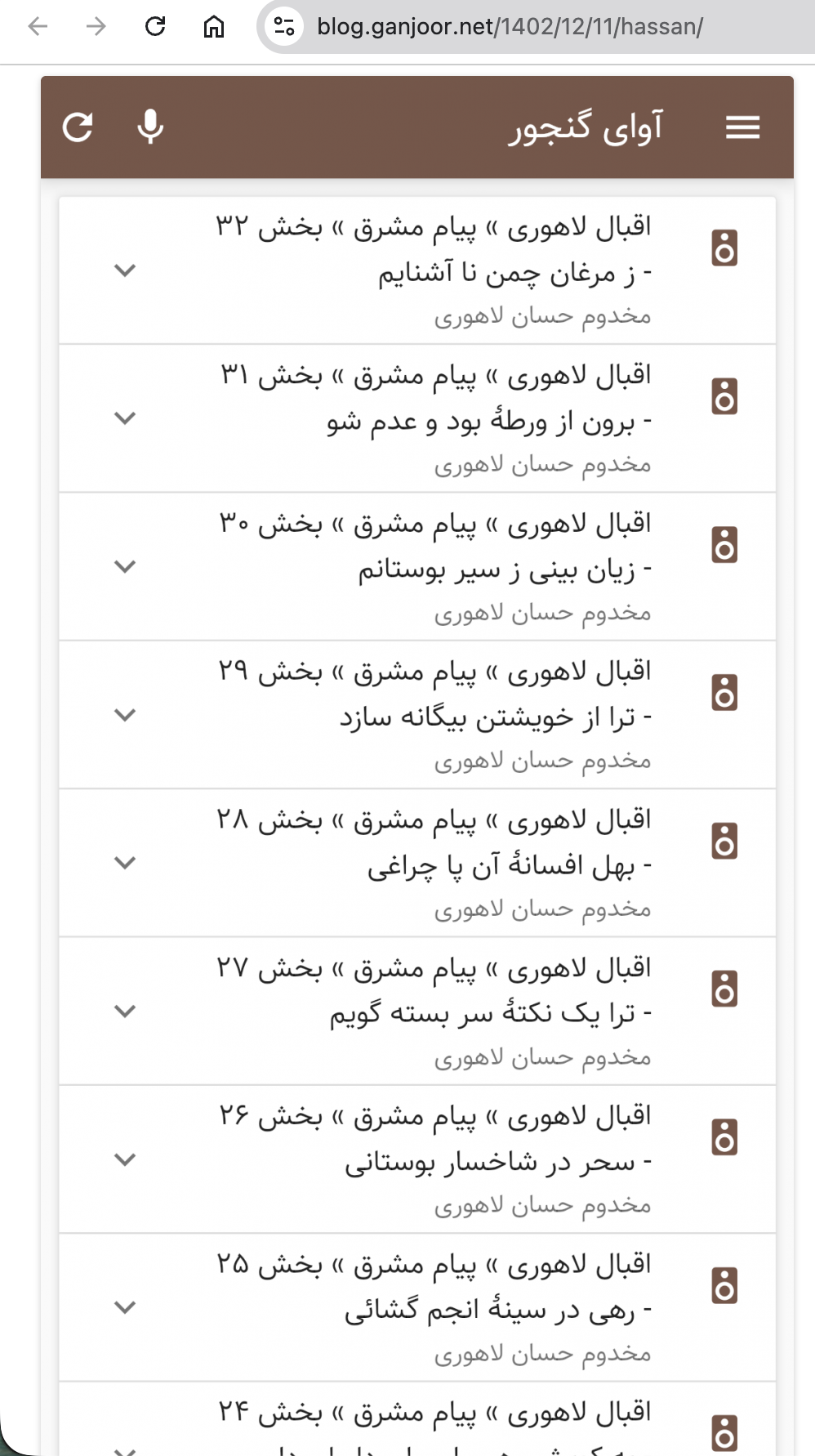
Recordings of Iqbal’s poetry on Avaye Ganjoor 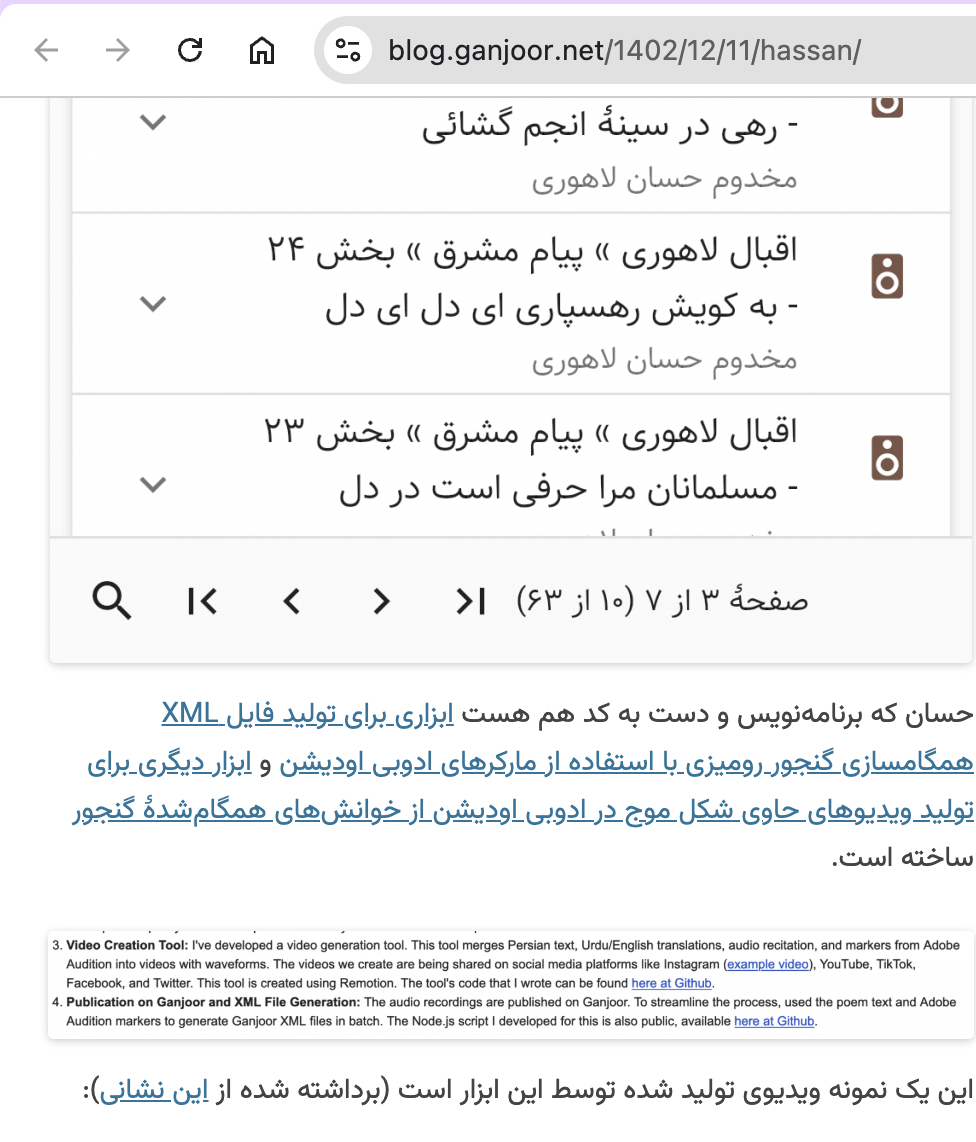
Mention of the XML and video tool 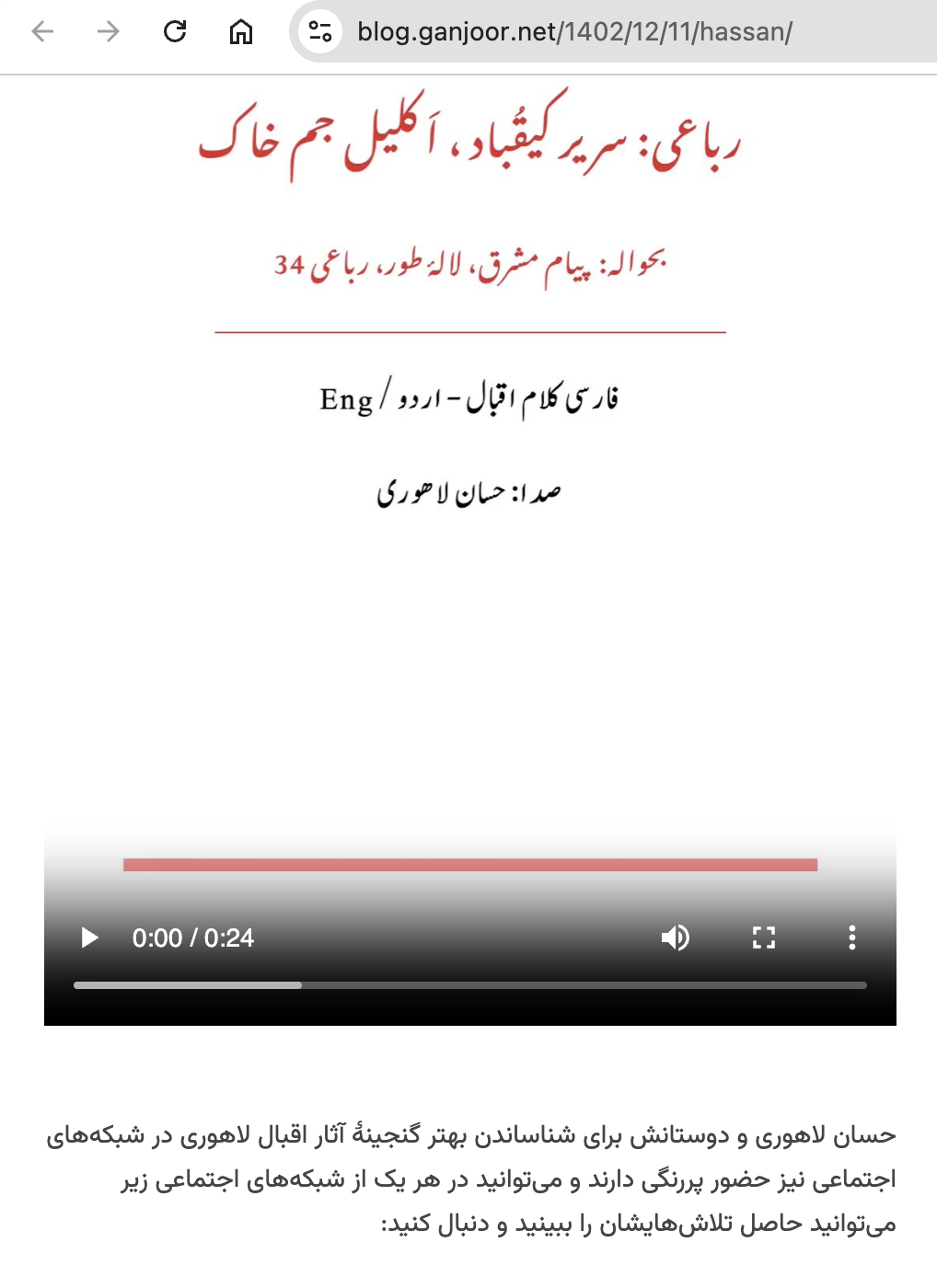
Video example - Adding new poets and texts: At the suggestion of Ahmad Javed, ZindeRood decided to add to Ganjoor works by noted Persian poets of the subcontinent that were missing from the platform. The project began with more than one hundred ghazals by Ghani Kashmiri. Muhammad Hassan undertook the demanding work of transcribing and proofreading the printed collection, after which ZindeRood’s founder delivered the text to the Ganjoor team. As a result of this work, Ganjoor formally recognised ZindeRood’s founder as one of its trusted sources for poetry texts. It listed him at number 33 out of 42 sources.
Trusted source
ZindeRood’s founder among Ganjoor’s approved sources
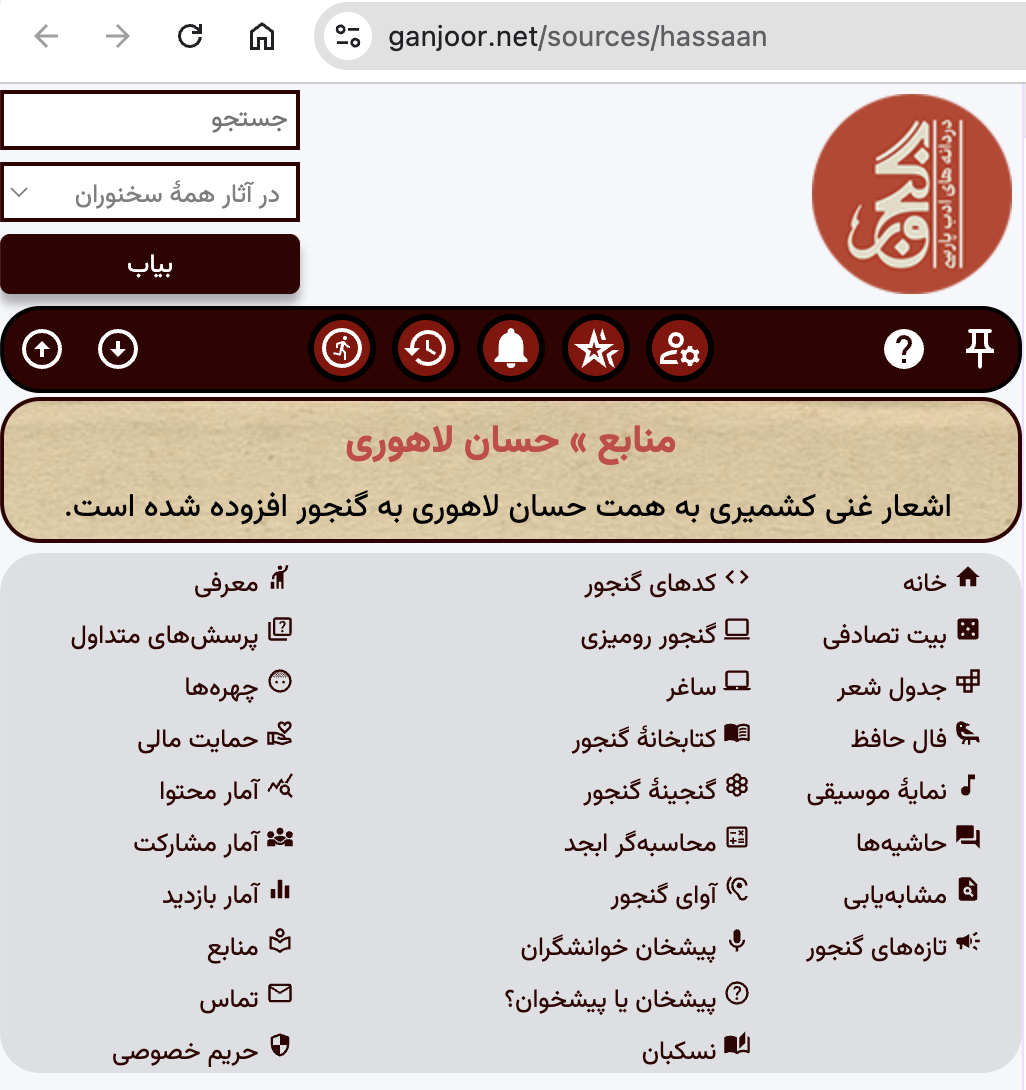
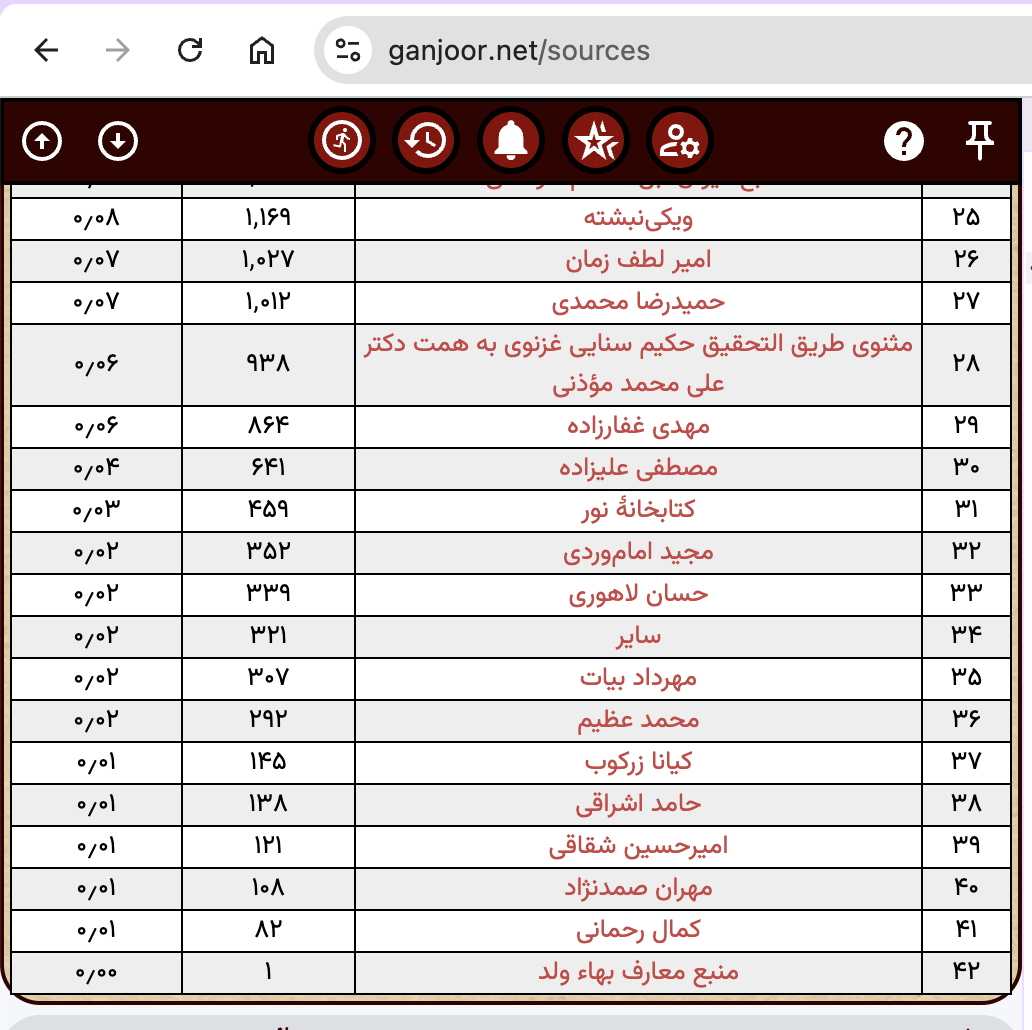
- Correcting Ganjoor’s data: ZindeRood drew the core Persian texts and recordings for its platform from Ganjoor. We reproduced the work of other poets as it appeared there, but Iqbal’s text contained many errors, so we began the painstaking task of correcting it. According to Ganjoor’s source notes, the text had come from the official website of Iqbal Academy Pakistan. Our team reviewed it closely and corrected the mistakes. The full list is long, but this example gives a sense of the problem:This is a poem from Armaghan-e Hijaz, and its text on Ganjoor is:It contains several errors, including کنن, زایدن, and زغوش. this text on ZindeRood was corrected. We cannot yet claim with certainty that every error in Iqbal’s poetry has been found and fixed. The work continues, and help from our readers can make the text better still. Even at this stage, however, Iqbal’s poetry on ZindeRood is more reliable and more carefully presented than the version currently available on Ganjoor.Restoring the internal structure: Ganjoor had largely overlooked the internal organisation of Iqbal’s books, including Armaghan-e Hijaz, Payam-e Mashriq, Javid-nameh, and Zabur-e ʿAjam. Many poems had been removed from their sections and placed in a single list, obscuring both their relationships and the shape of the books. Using the original editions published by Sheikh Ghulam Ali and Sons, ZindeRood restored the full structure and ordering of the poetry. For example, if you open Armaghan-e Hijaz on Ganjoor, hundreds of quatrains appear in a single list, without sections, individual poems, or any internal structure. That makes the book extremely difficult to read or understand as a whole. On ZindeRood, by contrast, the original edition’s carefully ordered structure has been restored. We have done the same for other books, following their printed editions. It has been painstaking work, but it makes each book legible again.
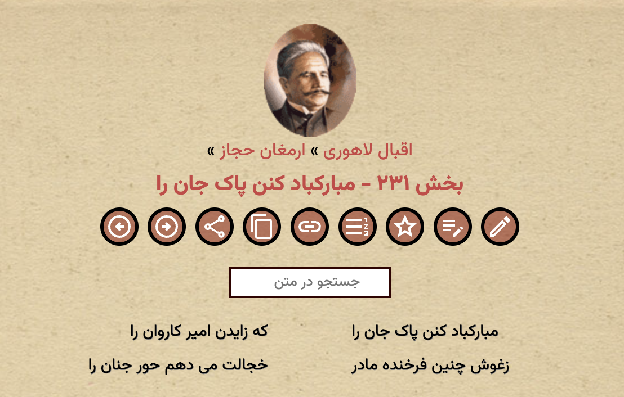
An example from the text on Ganjoor 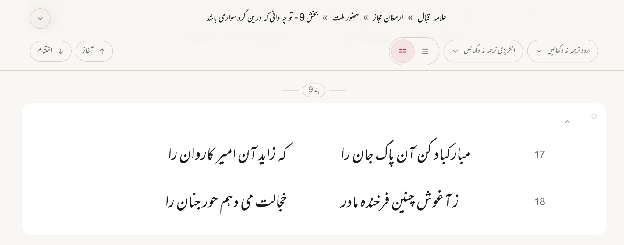
The corrected text on ZindeRood Once our review of Iqbal’s Persian poetry is complete, we will return the cleaner, corrected data to Ganjoor so that the errors can be fixed there as well. ZindeRood’s data will also be made available through open APIs for others to use. We believe in the same principle:Structure
Restoring the internal structure of books
The book without internal divisions on Ganjoor, beside the structure restored from the original edition on ZindeRood.
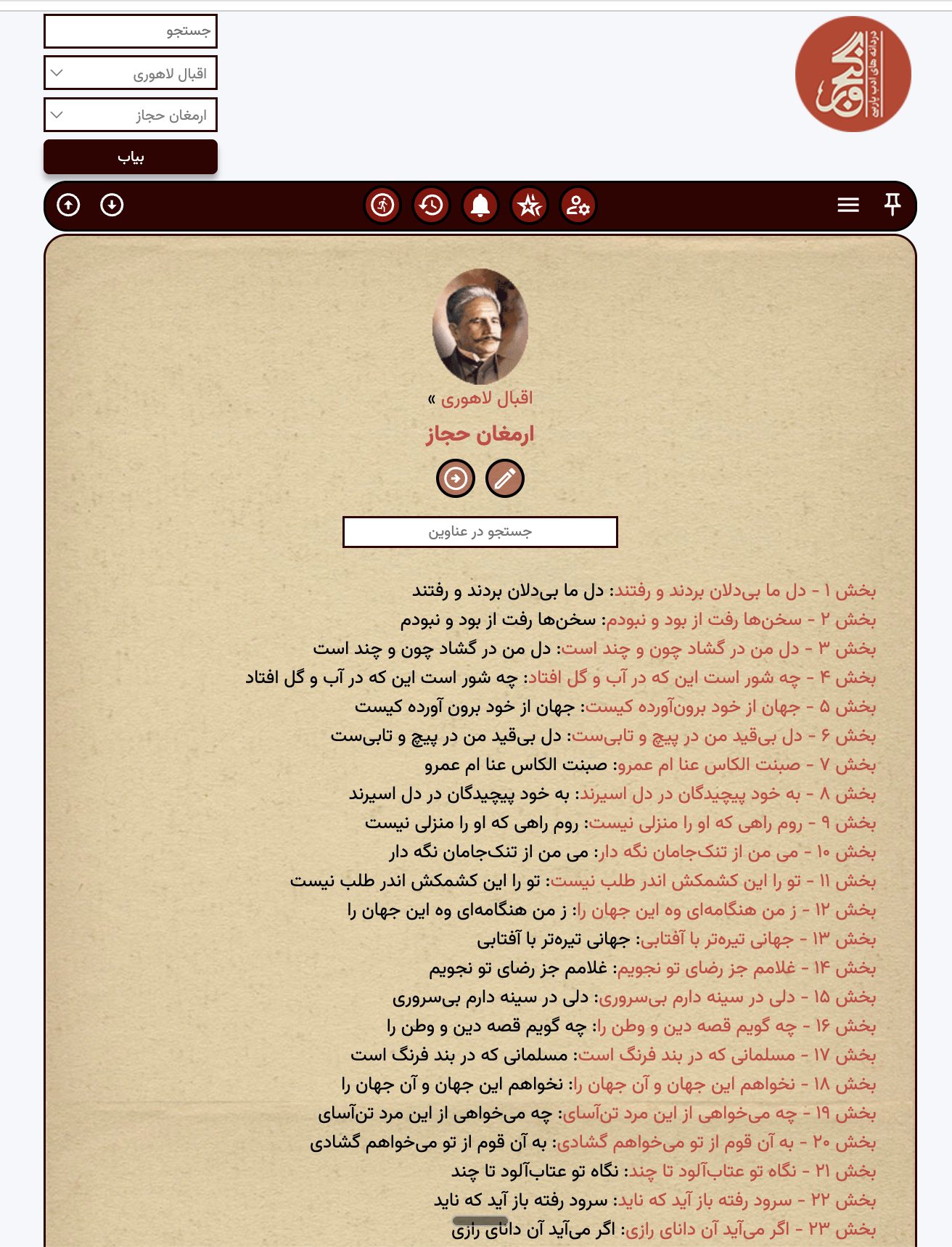
Armaghan-e Hijaz on Ganjoor 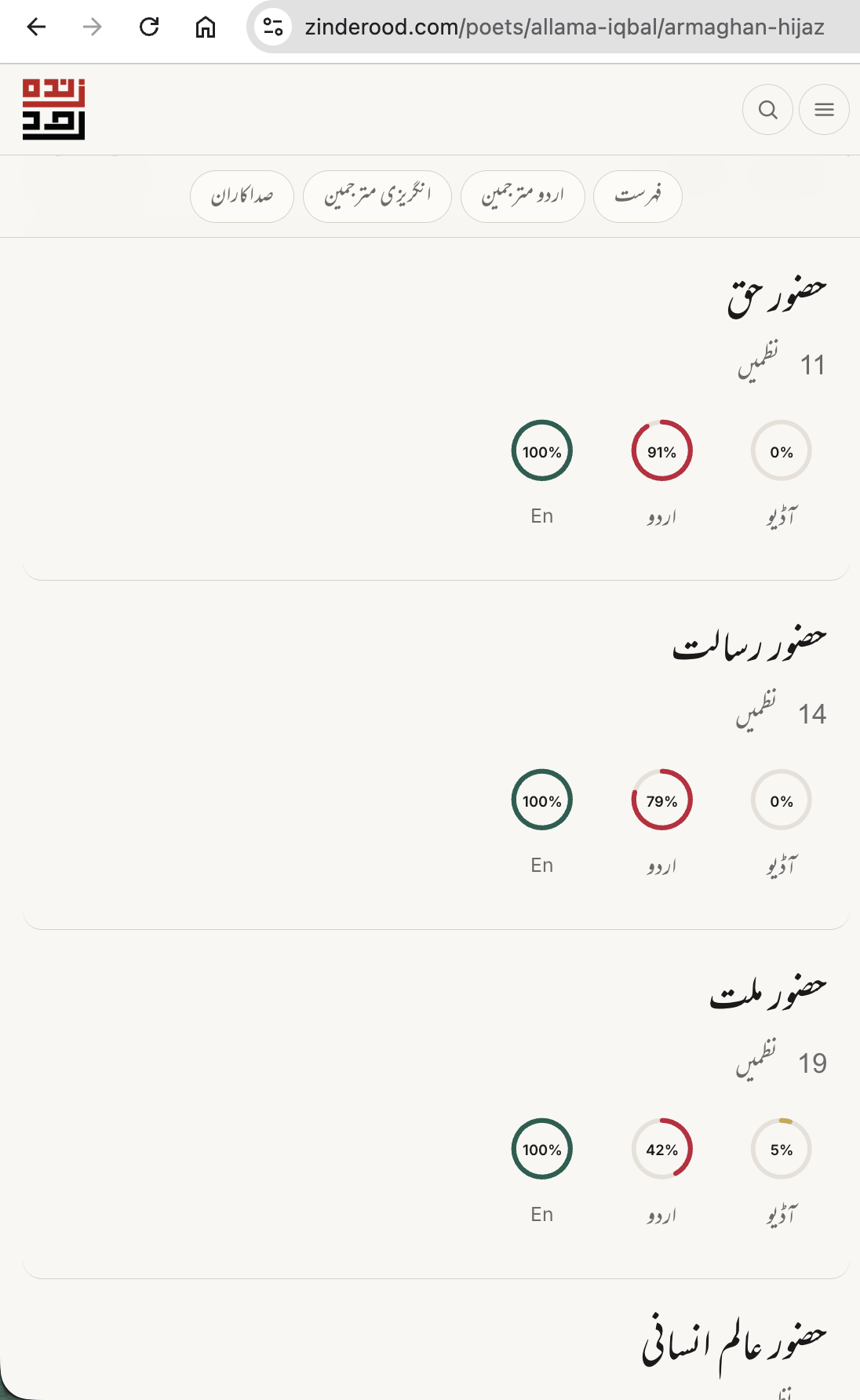
Armaghan-e Hijaz on ZindeRood «دگران کاشتند و ما خوردیم، ما بکاریم و دیگران بخورند»
Others planted and we ate; let us plant so that others may eat.