

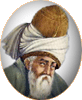
Poet
Rumi
Mawlana Jalal al-Din Muhammad Balkhi Rumi (1207–1273) was one of the greatest Persian Sufi poets, mystics, and thinkers. Born in Balkh, he later migrated with his family to Konya in Anatolia, where his scholarly, spiritual, and literary life reached its fullest expression. He is known throughout the world as Mawlana, Rumi, or Mawlavi.
Rumi’s father, Baha al-Din Walad, was a prominent scholar and Sufi. His teaching, followed by the guidance of Burhan al-Din Muhaqqiq Tirmidhi, played an important part in Rumi’s intellectual and spiritual formation. Rumi first made his name as a teacher, preacher, and jurist, and was counted among the leading scholars of his day.
His celebrated meeting with Shams al-Din Tabrizi in 1244 changed the course of his life. In the companionship of Shams, Rumi underwent a profound inner transformation and turned from formal scholarship towards love, mystical knowledge, and the journey of the soul. Much of his poetry and spiritual thought grew out of that encounter.
Rumi’s works include the Masnavi-ye Maʿnavi, the Divan-e Shams-e Tabrizi, his ruba‘iyat, letters, Fihi Ma Fihi, and Majalis-e Sabʿa. The Masnavi is one of the great works of Persian literature and Sufi thought, and one of the world’s most influential books of spiritual teaching. The Divan-e Shams stands at the summit of the Persian tradition of mystical love poetry.
Rumi died in Konya in 1273. For centuries his thought and poetry have nourished scholars, writers, and seekers in both East and West. He remains one of the most widely read poets in the world.