
Poet
Saadi
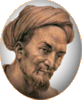
Musharrif al-Din Muslih ibn Abd Allah Saadi Shirazi (c. 1218–1294) was a great Persian poet, prose writer, and moralist. Persian literary tradition honours him as Ustad-e Sokhan, master of speech, Shaykh-e Ajal, the venerable master, and Padishah-e Sokhan, king of eloquence. Few writers have enjoyed equal distinction and popularity in both poetry and prose.
Saadi was born in Shiraz. After his early education, he studied literature, Qur’anic commentary, law, theology, and philosophy at the celebrated Nizamiyya in Baghdad. He then travelled widely through the Middle East and North Africa, including Syria, the Hijaz, Morocco, and Abyssinia. The people and places he encountered gave his writing much of its range, humanity, and worldly wisdom.
After returning to Shiraz, Saadi wrote the works for which he is best known. Bustan, completed in verse in 1257, was followed by Golestan in 1258, a finely balanced mixture of prose and poetry. Both are masterpieces of Persian literature and have been read for centuries as books of ethics, wisdom, and human experience.
Saadi’s collected works also contain qasidas, ghazals, qit‘as, tarji‘-bands, ruba‘iyat, prose discourses, and Arabic qasidas. He was the first Iranian poet whose work was translated into European languages, and he continues to be read and admired around the world.
Saadi died in Shiraz in 1294 and was buried there. His tomb, known as the Saadiyeh, remains an important literary and cultural destination.