

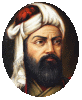
Poet
Nizami
Hakim Abu Muhammad Ilyas ibn Yusuf Nizami Ganjavi (c. 1135–1202) was one of the great masters of the Persian masnavi and a defining figure in classical Persian literature. He was born in Ganja, then an important cultural centre in the Caucasus. Through his narrative and romantic poetry, Nizami brought Persian storytelling to new heights and established a tradition that shaped Persian, Urdu, Turkish, and other literatures for centuries.
Nizami possessed a wide knowledge of the learning of his time. His familiarity with philosophy, religious studies, medicine, mathematics, astronomy, and music is evident throughout his work. This breadth of learning earned him a place not only among poets but also among the sages of the classical Persian world.
His best-known work is the Khamsa, or Panj Ganj, a collection of five long narrative poems: Makhzan al-Asrar, Khosrow va Shirin, Layla va Majnun, Haft Paykar, and the Iskandar-nameh. Together they are counted among the masterpieces of Persian literature and have been translated into many languages.
Nizami also wrote qasidas, ghazals, qit‘as, and ruba‘iyat, though it is the five masnavis that secured his worldwide reputation. He died in Ganja, where he remains the foremost representative of the romantic and narrative tradition in Persian verse.